0.x preview. It runs from a clone today; the npm package and the container images are not published yet.
A customer's record is wrong, and you can't tell which service changed it.
Wayscribe follows one record across your services, shows what each step received and what it produced, and points at the field that changed. It is free, self-hosted, and runs on your own PostgreSQL.
Search a customer, order or invoice ID, or any other identifier the record
answers to, and get that record’s history in order, across every service that
touched it. Open a step and see what it received next to what it produced, field
by field.
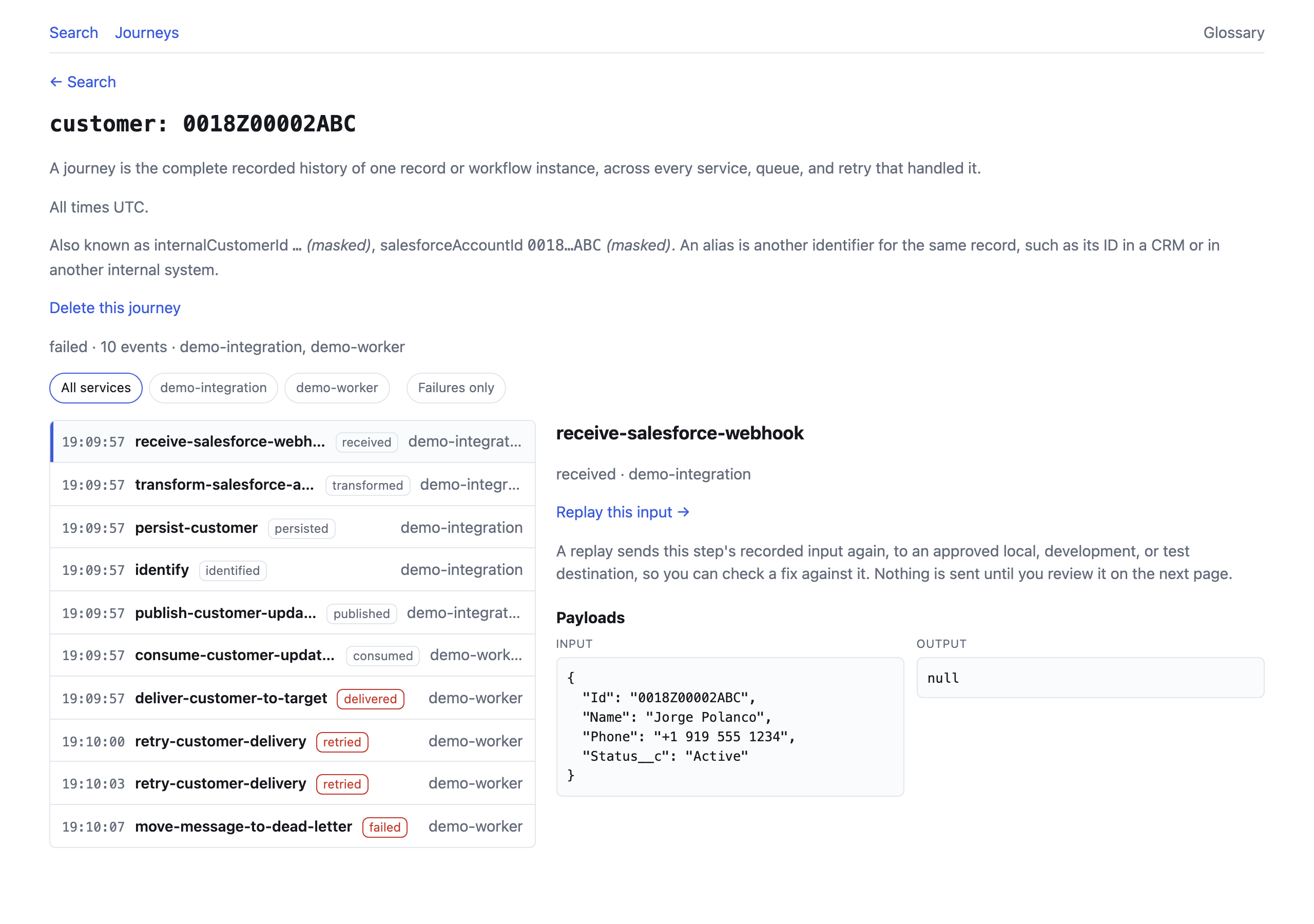
One record’s journey in the demo: ten steps across two services, ending in
the dead-letter queue.
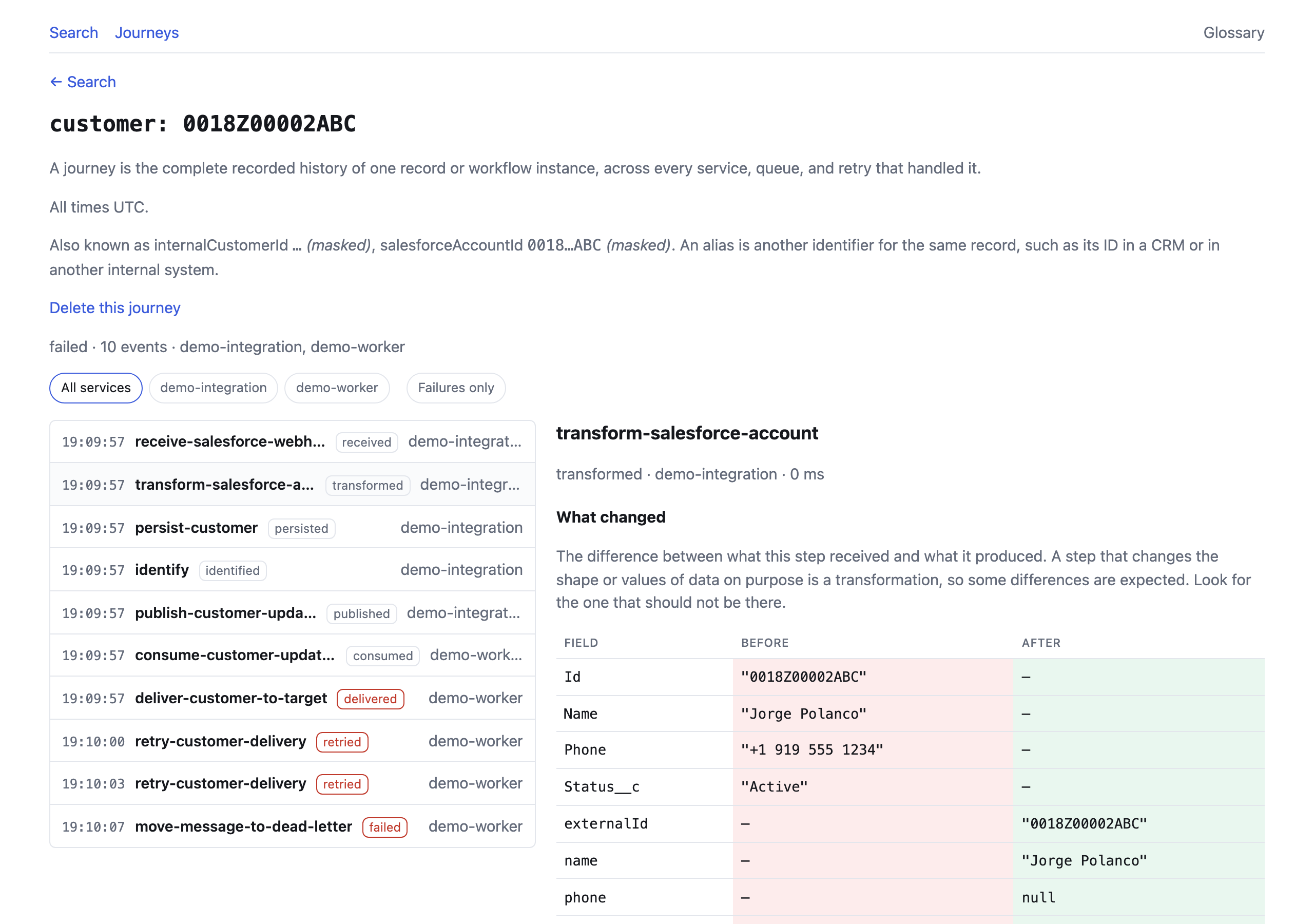
The transformation step: Phone went in with a value and phone came out
null. That pair is the bug, a mapping that reads Phone__c.
Then replay that step’s recorded input against your corrected code in
development, and compare the result with the original.
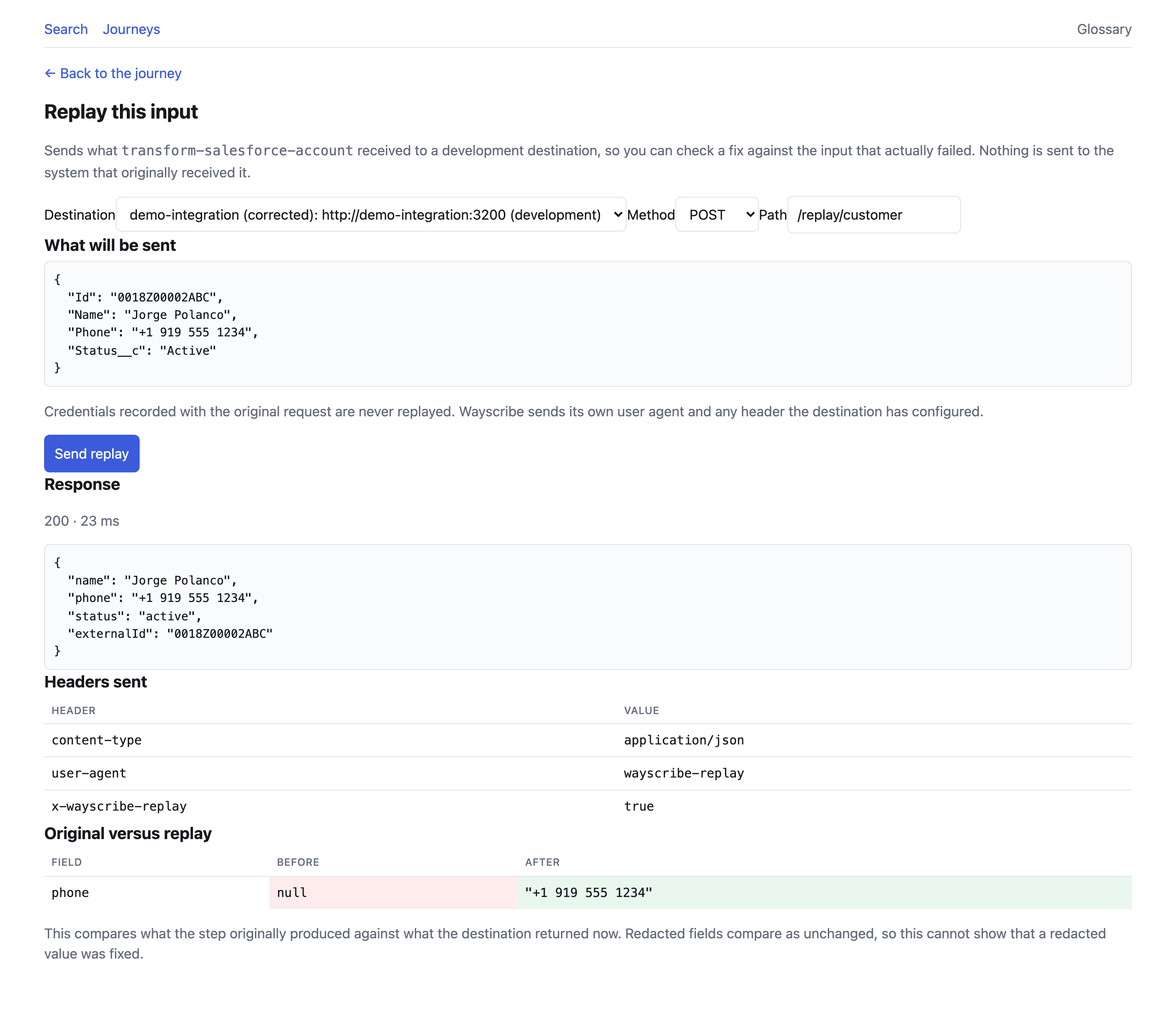
The same recorded input, sent to a corrected handler in development.
phone came back with its value, and the comparison names the one field
that changed. Nothing is sent until you have read what will be sent, and
the destination has to be on an allowlist.
You search by a business ID. One record is a Salesforce ID in one service,
an internal ID in another and a queue message ID in between; search any of
them and you get the same journey. Tracing finds a request by its trace ID.
Shows the field that changed
Each step records what it received and what it produced. The diff is
structural, a path with its value before and after, so a renamed field and a
lost value both show.
Replays a step against development
Rerun a step’s recorded input against a development destination on an
allowlist, and compare the new result with the recorded one. Replay to
production is not supported.
Runs on your own PostgreSQL
PostgreSQL is the only required backing service. No Kafka, no
Elasticsearch, no agent, no workflow engine to move your code onto. The SDK
wraps the code you already have.
It is not a replacement for OpenTelemetry. When OpenTelemetry is present, the
SDK reads the active trace and span IDs onto each event, so you can move
between the two.
As of September 2026, I have not found an open-source tool that does all four
for services you already run: (1) follow one record by its business id and
aliases across services; (2) capture what each step received and produced and
show the field that changed; (3) replay a recorded input against development;
(4) with no platform to move onto.
Several open-source tools do part of it:
Tool
What it does
What it lacks for this job
Apache NiFi provenance
Finds a piece of data, shows it at each step, replays it
Only data moving through a NiFi dataflow
Workflow engines such as Temporal
Keep each execution’s inputs and results, searchable
Only code written as their workflows
Tracing backends such as Jaeger or Grafana Tempo
Find traces by span attribute, such as an order id
No documented capture of step payloads, field diff or replay
Webhook servers such as Svix
Deliver webhooks with retries
Only the webhook, not the steps around it
Model-history libraries such as PaperTrail or django-simple-history
Record before and after values of a model’s fields
One application’s database models only
Traffic capture and replay such as Keploy and Kubeshark
Record traffic; Keploy replays it as tests
No record history by business id across services
Lineage standards such as OpenLineage
Lineage of jobs, runs and datasets
No single record in the model
Convoy, Bemi and n8n come close to parts of this and are source-available
rather than OSI open source. Commercial tools such as Nodinite, Turbo360,
Particular ServicePulse, Dynatrace Business Flow and the hosted tracing
backends, Honeycomb among them, do this job on their own platforms, which shows
teams pay for it.
docs/ALTERNATIVES.md has the licence, the overlap and
the gap for each, with a source and the date it was checked. If a tool does all
four, this claim is wrong: please
open an issue with a
link to it.
Alternatives, in fullEach tool's licence, overlap and gap, with a source and the date it was checked (16 September 2026).
That builds the images and starts the API, the interface, PostgreSQL, a queue,
and four demo services with a broken integration to investigate. Measured on
2026-09-14 from a fresh clone on a laptop with no Docker layer cache, the build
took 38 seconds and the boot 12; the first run also downloads the base images.
Then start a journey:
Terminal window
curl-XPOSThttp://localhost:3100/trigger
Open http://localhost:3000, sign in with the development admin token,
replace-for-local-development-0000, and search 0018Z00002ABC. Set your own
token and encryption key before the stack holds anything real; the
quick start shows how.
The Node SDK, @wayscribe/node, is not published on npm yet. Until it is,
pack it from a clone of the repository, commit the tarball to your application,
and install it by path:
Both excerpts come from the
Express, BullMQ and HubSpot recipe,
whose code the repository type-checks against the SDK on every pipeline. The SDK
needs Node.js 22.12 or later and has no runtime dependencies.
Node SDKThe full surface, configuration and guarantees.
RecipesExpress and BullMQ, Fastify and SQS, Next.js and Stripe.
Self-hosted. No account and no hosted service. Everything is kept in your
own PostgreSQL, 15 or later.
No telemetry. The running services send no telemetry and no analytics,
and make no outbound connection other than the ones your configuration
creates, such as replays to the development hosts you allow. This site has no
analytics, no trackers and no cookies either.
Apache-2.0, for every package, the SDK included.
Redaction by field name, at any depth: in the SDK before a payload leaves
your process, and again on the server before it is stored. A credential under
a name no rule knows is warned about, not redacted. Entity identifiers and
alias values are encrypted at rest; payloads are stored as plain jsonb after
redaction.
A security review packet for the engineer deciding on a pilot: data,
authentication, deletion, supply chain and known gaps, each linked to its
source. The pre-release security review it cites (2026-09-16) was done by an
AI review agent at the maintainer’s direction. It is not an independent audit,
and no outside party has reviewed the code.
A 0.x preview. Nothing is published yet: no npm package and no container
images. Releases will be 0.x, where a minor release may change the API.
How it is built. AI agents write most of the code; the maintainer makes
the decisions, and each is recorded with its reasoning in the decision log.